
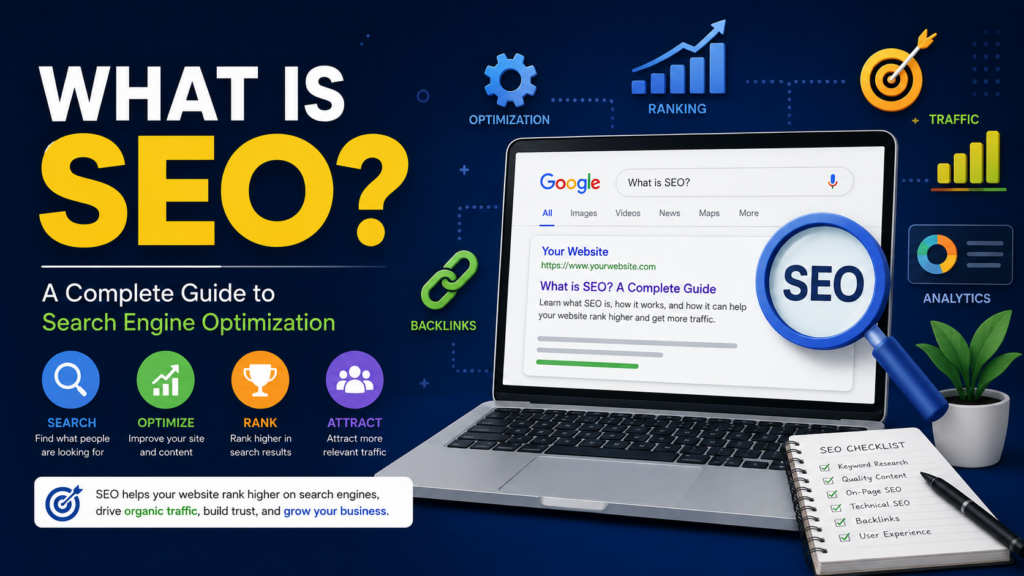
SEO stands for Search Engine Optimization. It is the process of improving a website and its content so that search engines can better understand, index, and rank its pages in organic search results. SEO is one of the most important digital marketing strategies for businesses, bloggers, e-commerce websites, and organizations that want to increase their online visibility.
When people search for information, products, or services on search engines such as Google, they usually click on results that appear near the top of the search results page. SEO helps websites improve their chances of appearing prominently for relevant searches.
What Is SEO?
Search Engine Optimization (SEO) is a collection of strategies and techniques used to improve a website’s visibility in unpaid or organic search engine results.
For example, if you own a digital marketing website and publish an article targeting the keyword “what is digital marketing,” SEO can help search engines understand your content and determine whether it is useful for people searching for that topic.
SEO involves several areas, including keyword research, content optimization, technical improvements, website structure, internal linking, user experience, and earning relevant backlinks.
The main goal of SEO is not simply to attract more visitors. Effective SEO aims to attract relevant visitors who are genuinely interested in the website’s content, products, or services.
Why Is SEO Important?
SEO is important because search engines are a major source of website traffic. When your website ranks well for relevant keywords, potential customers can discover your business without you having to pay for every click.
Some major benefits of SEO include:
- Increased organic website traffic
- Improved online visibility
- Greater brand awareness
- More potential customers
- Better user experience
- Increased credibility and trust
- Long-term marketing benefits
- Higher opportunities for leads and sales
Unlike some forms of paid advertising, organic search traffic can continue generating visitors after the initial SEO work has been completed. However, SEO requires ongoing improvement because search algorithms, competitors, and user behavior continue to change.
How Does SEO Work?
Search engines use automated systems to discover and organize information available on the web. These systems generally crawl web pages, analyze their content and structure, and store information in a search index.
When someone performs a search, the search engine uses various signals to determine which indexed pages are most relevant and useful for that particular query.
SEO helps make a website easier for search engines and users to understand.
For example, a well-optimized page may have a clear title, useful content, descriptive headings, relevant keywords, helpful internal links, optimized images, and a mobile-friendly design.
Types of SEO
SEO can be divided into several major areas. The three most commonly discussed types are On-Page SEO, Off-Page SEO, and Technical SEO.
On-Page SEO
On-Page SEO refers to optimization techniques performed directly on a website’s pages.
It includes optimizing elements such as:
- Page titles
- Headings
- Meta descriptions
- Website content
- Keywords
- URLs
- Images
- Internal links
- Content structure
High-quality content is an important part of on-page SEO. Content should be useful, original, easy to understand, and created primarily for people rather than simply written to manipulate search rankings.
For example, if you are writing an article about SEO, you can naturally use related terms such as “search engine optimization,” “SEO strategy,” “keyword research,” and “organic traffic” where they are relevant.
Off-Page SEO
Off-Page SEO refers to activities performed outside your own website that can contribute to its reputation, authority, and visibility.
One well-known aspect of off-page SEO is link building. A backlink occurs when another website links to your website.
Relevant and trustworthy backlinks can help search engines understand that other websites find your content valuable. However, the quality and relevance of links matter more than simply obtaining a large number of links.
Off-page SEO can also involve brand mentions, digital public relations, content promotion, and building relationships within an industry.
Technical SEO
Technical SEO focuses on improving the technical aspects of a website so that search engines can crawl, understand, and index its pages effectively.
Important areas of technical SEO include:
- Website speed
- Mobile usability
- Site architecture
- XML sitemaps
- Robots.txt
- HTTPS security
- Canonical URLs
- Structured data
- Crawlability
- Indexability
A technically strong website provides a better foundation for other SEO activities.
What Is Keyword Research?
Keyword research is the process of identifying the words and phrases people use when searching for information, products, or services online.
For example, someone interested in SEO might search for phrases such as:
- What is SEO?
- How does SEO work?
- SEO for beginners
- SEO strategies
- How to improve website ranking
Keyword research helps content creators understand what their target audience is looking for.
However, successful SEO is not about repeatedly inserting the same keyword into an article. Search engines have become much better at understanding context and user intent. Content should therefore use keywords naturally while providing comprehensive information that satisfies the searcher’s needs.
What Is SEO Content?
SEO content is content created to provide useful information to an audience while also being structured and optimized so that search engines can understand it.
SEO-friendly content should have a clear purpose and answer the questions users are actually asking.
A good SEO article generally includes an informative title, logical headings, short paragraphs, relevant keywords, useful examples, internal links, and a clear conclusion.
Content quality is more important than simply meeting a specific word count. A 1,000-word article should provide genuine value rather than unnecessary repetition.
What Are Backlinks in SEO?
Backlinks are links from one website to another website. They are often considered an important part of off-page SEO.
For example, if a respected marketing website links to one of your articles as a useful resource, that link can help people discover your content and may contribute to your site’s authority.
However, website owners should avoid spammy or manipulative link-building practices. Building useful content that people naturally want to reference is a sustainable approach to earning links.
SEO vs Paid Advertising
SEO and paid search advertising are two different approaches to gaining visibility in search engines.
With SEO, businesses work to improve their organic rankings and attract unpaid search traffic. With paid advertising, businesses pay to display advertisements for selected search queries.
Paid advertising can provide immediate visibility, while SEO generally requires more time and consistent effort. Many businesses use both strategies as part of a broader digital marketing plan.
Common SEO Mistakes
Beginners often make several mistakes when trying to improve website rankings.
One common mistake is keyword stuffing, which means using a keyword excessively and unnaturally throughout a page. This can make content difficult to read and may provide a poor user experience.
Other common mistakes include publishing low-quality content, ignoring mobile users, using misleading titles, creating duplicate content, neglecting website speed, and building low-quality backlinks.
Another mistake is expecting immediate results. SEO can take time, particularly for new websites and highly competitive keywords.
How to Measure SEO Success
SEO performance should be measured using relevant data and business goals.
Important SEO metrics can include:
- Organic traffic
- Keyword rankings
- Click-through rate
- Search impressions
- Conversions
- Leads
- Revenue
- Indexed pages
- Backlinks
- Engagement metrics
Website owners can use analytics and search performance tools to understand how visitors discover and interact with their content.
The most important metric depends on the purpose of the website. For an online store, conversions and revenue may be more important than traffic alone. For a blog, organic traffic and engagement may be useful indicators of performance.
How to Improve SEO
Improving SEO requires a combination of quality content, technical optimization, and a strong understanding of the target audience.
Start by researching relevant topics and keywords. Create helpful content that directly answers user questions. Organize your website with clear navigation and logical headings.
Make sure your website works well on mobile devices and loads efficiently. Use descriptive page titles and URLs, optimize images, and create useful internal links between related pages.
You should also regularly review older content and update it when information becomes outdated.
Most importantly, focus on creating a website that provides a positive experience for visitors.
Conclusion
SEO, or Search Engine Optimization, is a powerful digital marketing strategy for improving a website’s visibility in organic search results. It involves content optimization, keyword research, technical improvements, website structure, internal linking, and off-page activities such as earning relevant backlinks.
A successful SEO strategy focuses on both search engines and users. Instead of trying to manipulate rankings, website owners should create helpful content, maintain a technically healthy website, understand their audience, and continuously improve their online presence.
Whether you are a blogger, small business owner, freelancer, or e-commerce entrepreneur, learning SEO can help you attract relevant visitors and build sustainable online visibility. With consistent effort and a user-focused approach, SEO can become an important part of your long-term digital marketing strategy.